01
The rulebook
A guide to the world and the procedures for resolving actions. Think of it as the shared language of play.
Turn the places, characters and possibilities inside your book into an experience readers can play.
Try a short adventure →RPG means Role-Playing Game. Participants take on fictional characters and make decisions inside an imagined world.
A novel might follow a hero saving a kingdom. An RPG lets readers create their own characters in that kingdom, investigate a forgotten ruin, negotiate with its inhabitants and decide whose cause to support.
The adaptation can expand your universe through new adventures. It does not need to retell the novel.
Try it for yourself →A guide to the world and the procedures for resolving actions. Think of it as the shared language of play.
A record of a character’s abilities, relationships, equipment and goals. It makes their choices concrete.
A picture of places worth exploring. Maps can show a whole kingdom, one town or a single mysterious room.
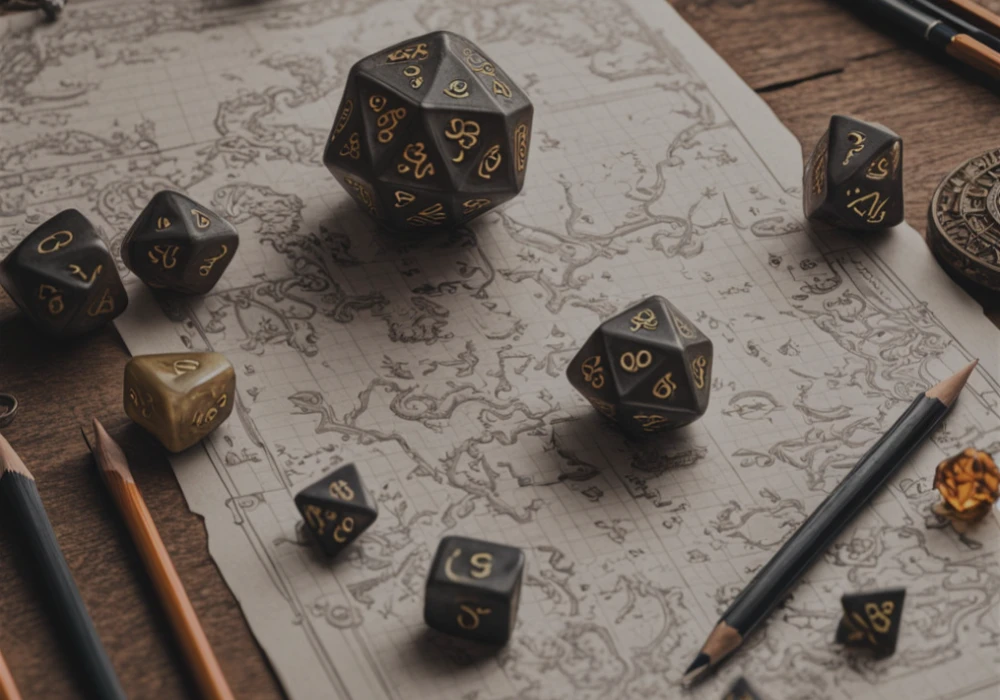
When an outcome is uncertain, dice can introduce surprise. Some games use cards, prompts or other procedures instead.
Players describe actions together. A Game Master may portray the world and its inhabitants.
A situation with stakes, obstacles and possibilities. Players decide how to approach it.
No. A beginner adaptation can explain its rules as it introduces the world.
A tabletop RPG can use a printed or digital PDF, character sheets and dice. Online play is also possible.
Yes. Solo RPGs use prompts, tables and rules to provide surprises without a group or Game Master.